
The salvage team of Dave’s Welding and Nelson Diving came to the rescue for a second time this winter when they raised a 48-foot-long, two-story camp barge that was partially submerged and resting …
This item is available in full to subscribers.
To continue reading, you will need to either log in to your subscriber account below or purchase a subscription.
Please log in to continue |
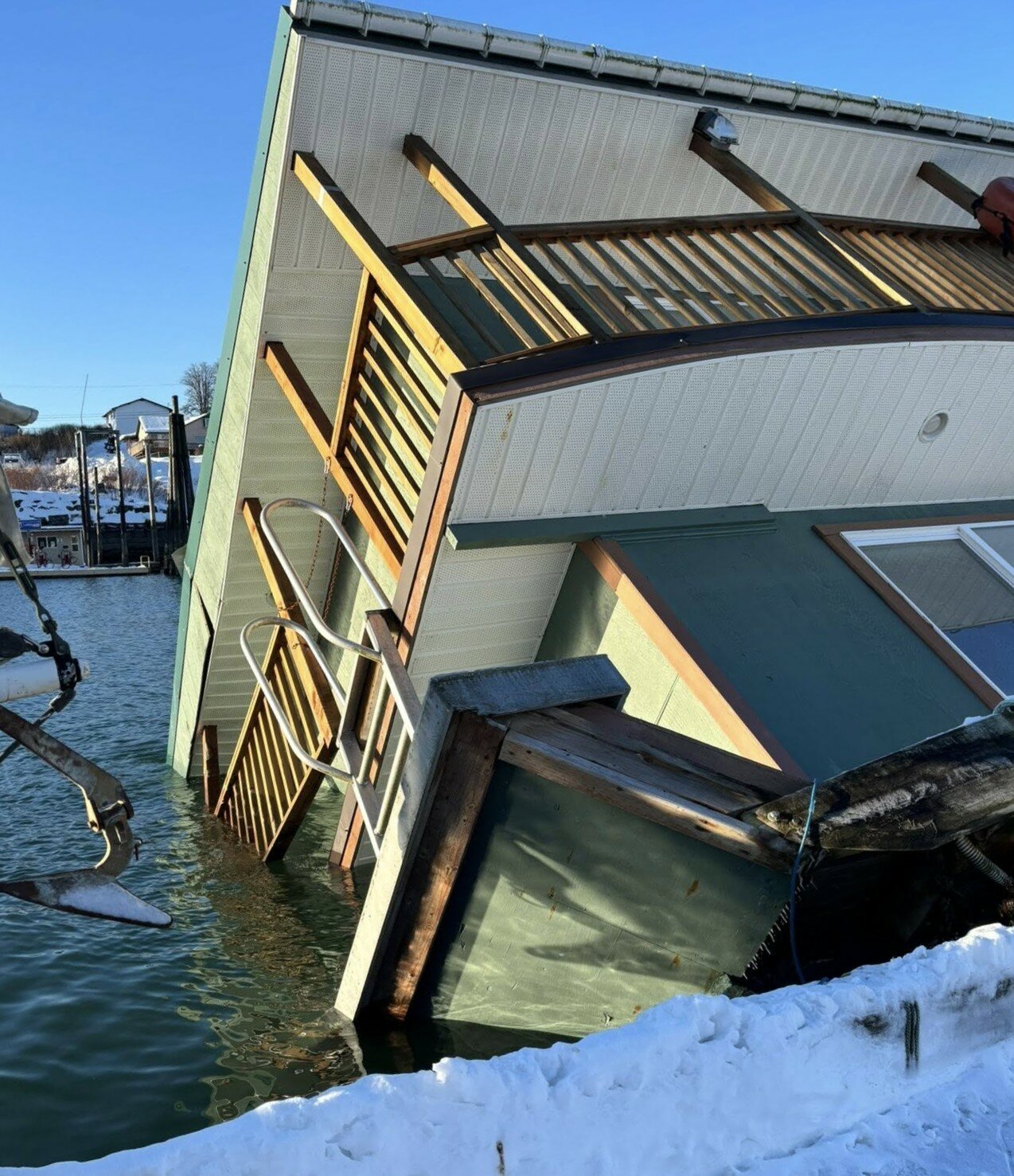
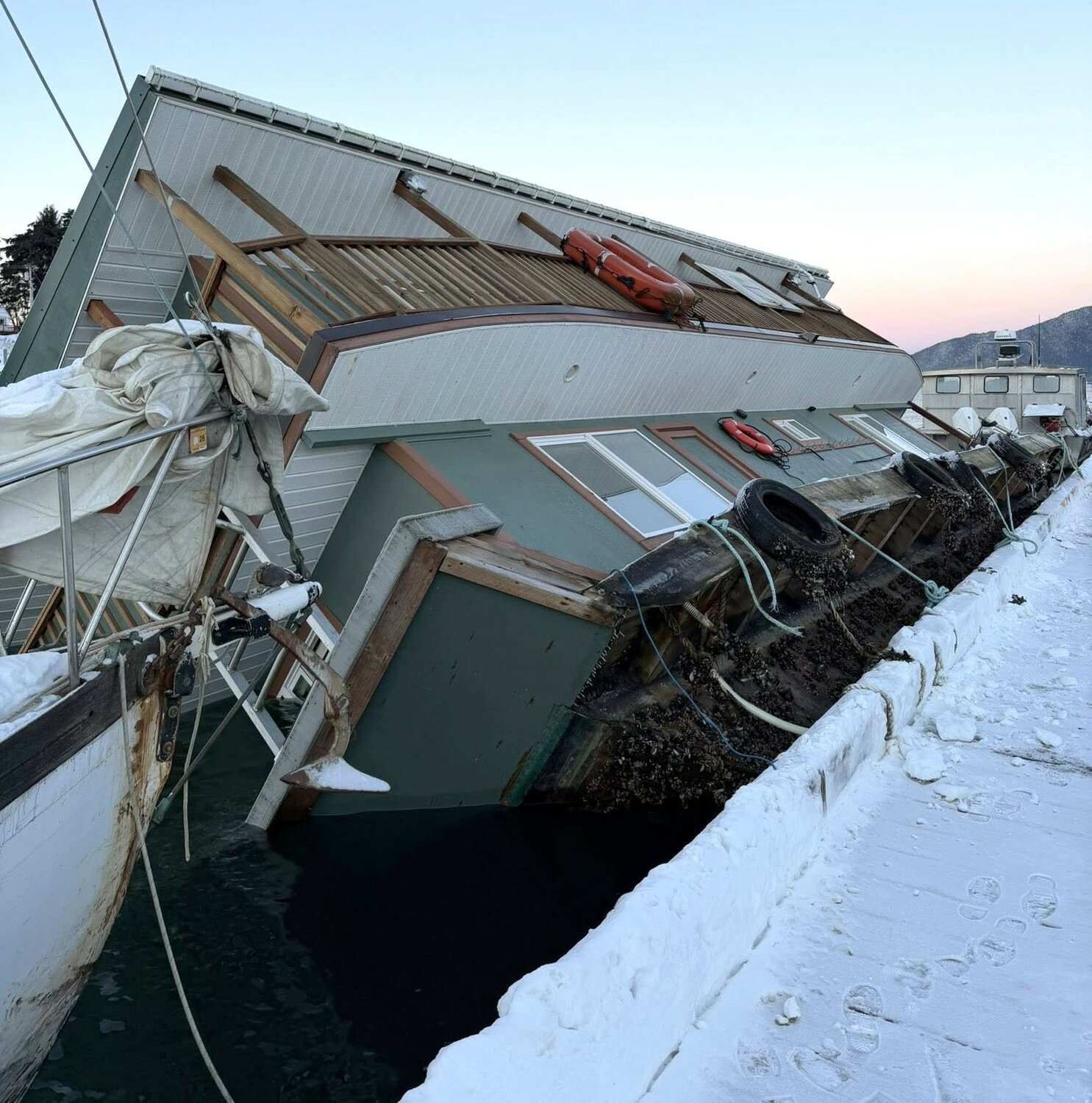


The salvage team of Dave’s Welding and Nelson Diving came to the rescue for a second time this winter when they raised a 48-foot-long, two-story camp barge that was partially submerged and resting on the bottom at Reliance dock.
The salvage operation was successful and the barge, owned by the Wrangell Cooperative Association, was beached and tied off for safekeeping for now at the back of the downtown harbor basin, near the municipal power plant.
The Dec. 27 recovery operation extended into the next day, said Dave Miller, of Dave’s Welding and Repair, who worked with James Nelson, of Nelson Diving, to raise, stabilize and move the vessel to the beach.
The 48-by-28 wooden barge with five staterooms and two bathrooms on two levels was the largest vessel Miller and his crew have ever pulled out of the water, he said.
It was listing over so far in the water that even he gave himself only a 50-50 chance of success.
“We had a lot of people betting against us,” he said in an interview Dec. 29.
“The barge was completely full of water,” and half of the first story was saturated from sitting in the water.
WCA took ownership of the barge in the past year, said Albert Rinehart, tribal administrator, who started work in June.
The camp barge, which was built in 1970, had been used by Alaska Crossings, which ran a residential wilderness program for at-risk children. SEARHC took over the program in 2017 but closed the Wrangell operation in January 2022, citing rising costs.
SEARHC later gave the camp barge to WCA, Rinehart said. The tribal council has been trying to sell the floating housing, advertising for bids this past summer at a $50,000 minimum asking price.
“We had an offer on it,” Rinehart said. “We’ve been trying to sell it for quite some time.”
The structure atop the barge has a full kitchen, common rooms on both levels, and comes with two auxiliary floats for a generator, incinerator and storing gear.
Miller said the barge itself is sturdy construction, built from 3-inch-thick yellow cedar planks covered with plywood more than an inch thick and sealed.
Rinehart said WCA is working to determine the cause of the partial sinking. Miller said he believed a split seam in one corner was the culprit.
“We made sure it was stable and pumped out,” Rinehart said of the barge’s temporary home on the beach.
It’s the only vessel owned by WCA.
“We’re looking at possibly selling it even still, at even a lower price,” Rinehart said. If not, “we’re going to end up with the further expense of demolishing it.”
The recovery effort started when the call came in the morning of Dec. 26. Nelson put on his drysuit and dove under the barge to make a plan to raise the vessel. He and Miller’s crew returned Dec. 27 and worked all day.
Nelson has four inflatable lift bags capable of raising 2,000 pounds each. The heavy rubberized bags inflate to 4 feet by 6 feet, “like a giant pillow,” he said.
Setting a compressor on the dock and running lines from a manifold so that he could adjust the air flow to the floats bags, Nelson adjusted the position of the bags multiple times during the operation.
Part of the barge had hit the bottom, he said, though its lines to the dock held it up and kept it from going completely under.
Miller’s crew hooked lines to the barge and pulled to keep it from rolling over any further into the water. “We supply all the manpower,” the compressors and chains and ropes, working in concert with Nelson and his air bags.
The team was able to lift the sunken portion of the barge about 7 to 10 feet, bringing it pretty much level, Nelson said. They pulled the vessel to a deeper point in the harbor basin, pumped out the barge and, at high tide, had enough clearance to tow the barge from Reliance to the back of the harbor basin.
He credits much of the success to Miller. “He has a heck of a crew.” Nelson noted that it was warmer for him in the water than it was for Miller’s workers on the float, standing in 20-degree weather with wind gusts over 20 mph.
“Although it took longer than all involved had hoped (and) fighting horrible winter weather conditions,” the team effort was able to stabilize the barge and prevent serious damage to the dock, Miller said.
There was little damage to the dock, said Harbormaster Steve Miller.
“It was quite challenging,” said Nelson. “We were maxed out. It took everything we had,” adding that he plans to buy some larger float bags.
Salvage work “is a side job for me,” he said. Most of his diving calls are to help fishermen, such as when their net wraps around the prop. He’s been answering calls for about 20 years, he said, stepping up his work the past 10 years.
“My 18-year-old son has been beside me since he was 8 years old. … I want him to take over.”
Nelson’s day job is working as a law enforcement officer with the U.S. Forest Service.
Miller said his crew finished the job about 6 a.m. Sunday morning, Dec. 28, and then he went home for a one-hour nap before going back to check on the barge.
The same salvage crews worked together Dec. 18 to raise the Little Darling, a 48-foot pleasure boat that was two-thirds submerged at its moorage stall at Heritage Harbor.
After two big jobs in 10 days, “we’re hoping we’re done for the year,” Miller said.


